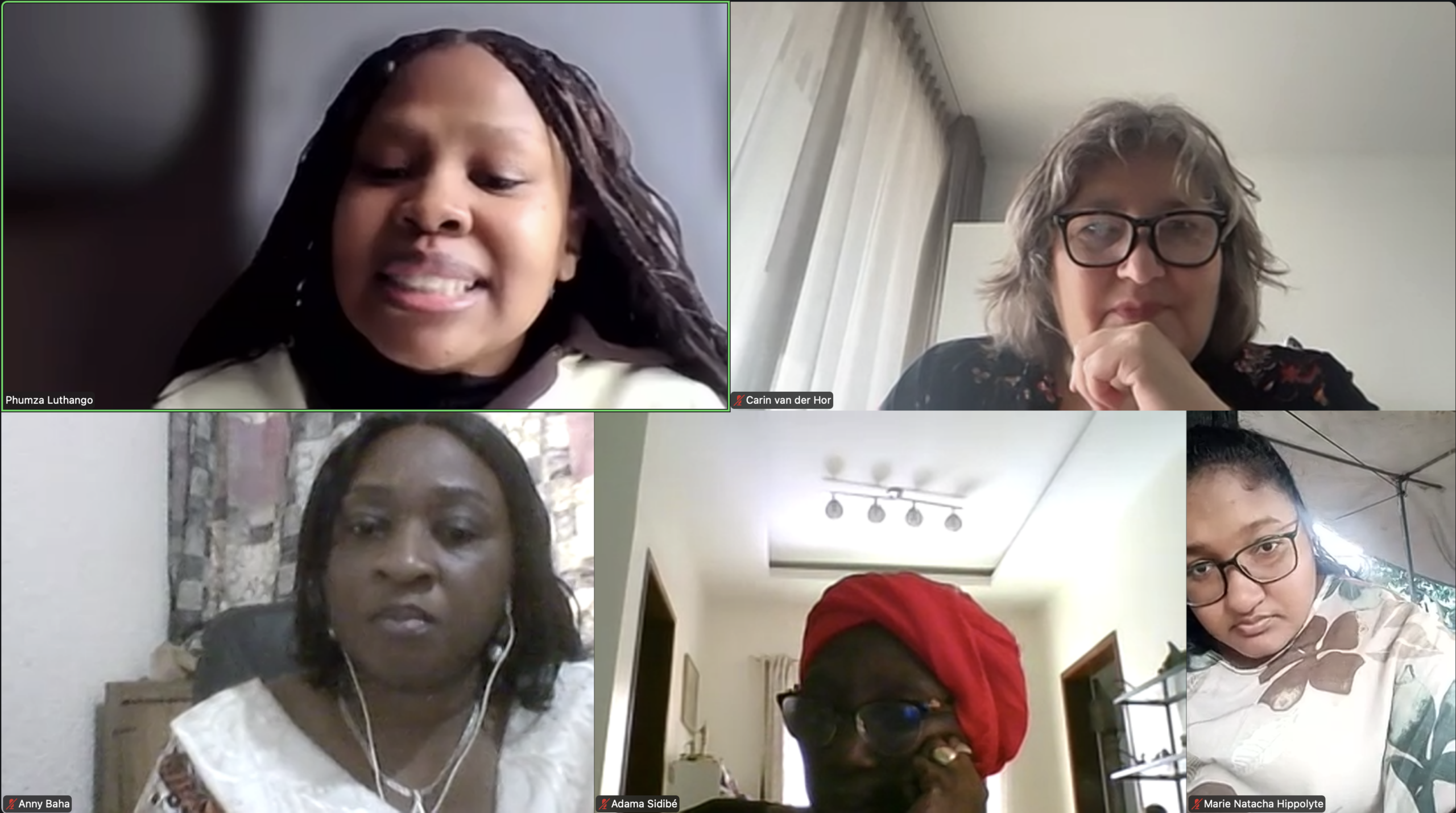
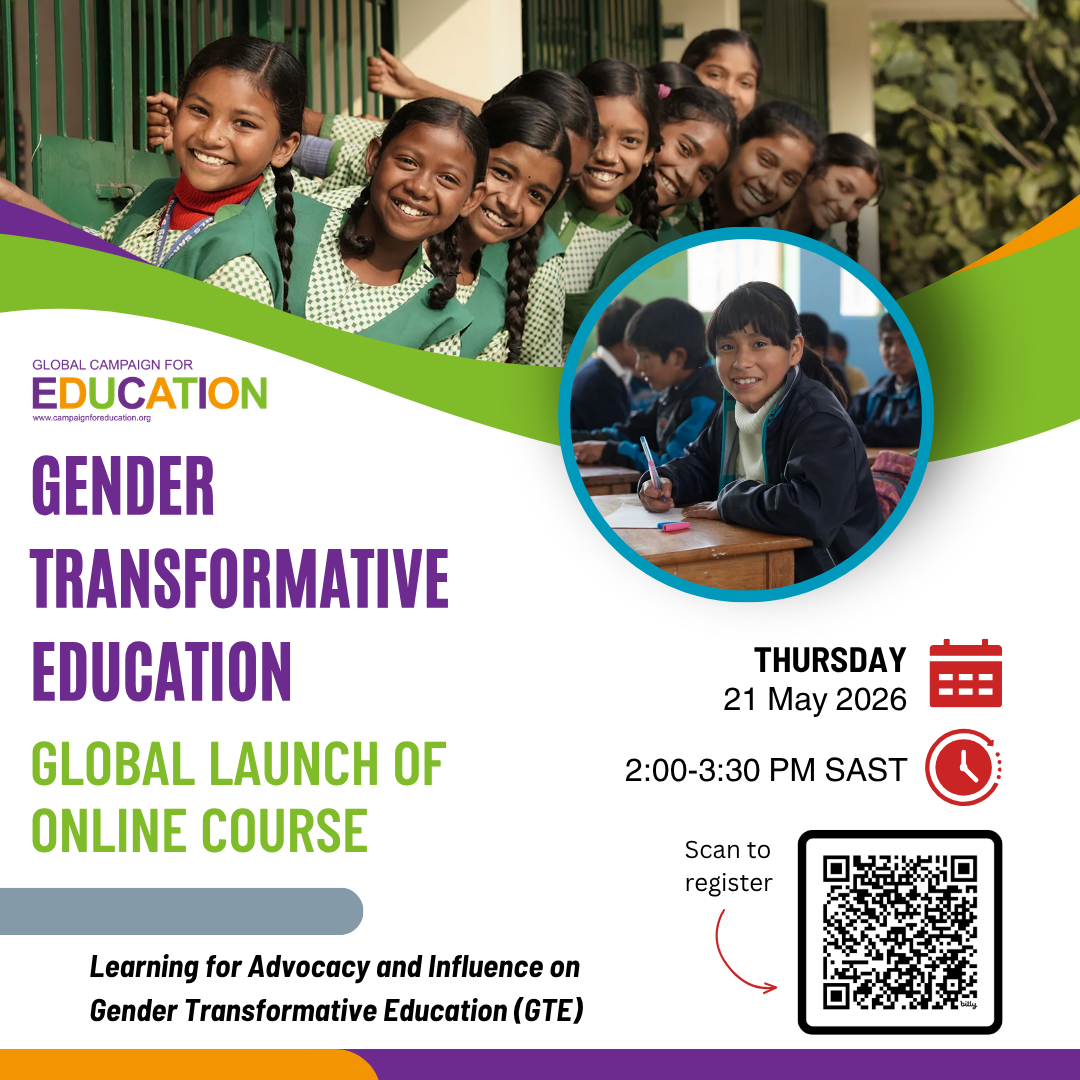
On 21 May 2026, the Global Campaign for Education (GCE) brought together its members and partners to launch Learning for Advocacy and Influence on Gender Transformative Education (GTE), a new online course for civil society advocates and coalitions. The course is designed to translate commitments on gender equality and social inclusion into concrete action in classrooms, communities, and policy arenas.
Grounded in practical application, it equips participants to analyse education systems, identify barriers to inclusion, and develop actionable advocacy strategies. It also addresses the realities of working in diverse and often challenging contexts, including humanitarian settings where existing inequalities are frequently intensified. By strengthening skills in advocacy and policy engagement, the course seeks to build collective power and drive systemic change towards truly gender transformative education.
Why gender transformative education, and why now?
GCE Gender Lead, Susmita Choudhury, highlighted that 273 million children and young people remain out of school, with 133 million excluded due to intersecting factors such as gender, poverty, disability, location, and displacement. Children with disabilities face particularly unsupportive learning environments, weakening their foundational skills.
These inequalities stem from systemic discrimination, harmful norms, and chronic underfunding. Conflict and crises intensify exclusion, with girls often the first to leave school and the last to return. While many countries have progressive policies, weak implementation, limited capacity, poor coordination, and a widening global education financing gap mean commitments rarely reach the most marginalised learners.
GCE members already work to influence policy, hold governments to account, and advocate for equitable financing. What they need, Susmita noted, are practical tools, structured learning, and a shared framework to push for truly gender transformative education systems. The new course has been developed to meet that need.
A practical, interactive course for advocates
GCE Knowledge Exchange and Learning Lead, Phumza Luthango, described the course as intentionally practical and co-created with civil society.
The six modules blend foundations with hands-on tools:
- Updated concepts on gender equality and social inclusion in and through education.
- In-depth exploration of gender-transformative education (GTE) and gender, social equality, and inclusion (GSEI), and how coalitions integrate these into advocacy.
- Disability inclusion and education in crises, emergencies and fragile contexts.
- Education financing and gender-responsive, inclusive budgeting, enabling advocates to assess whether resources reflect policy promises.
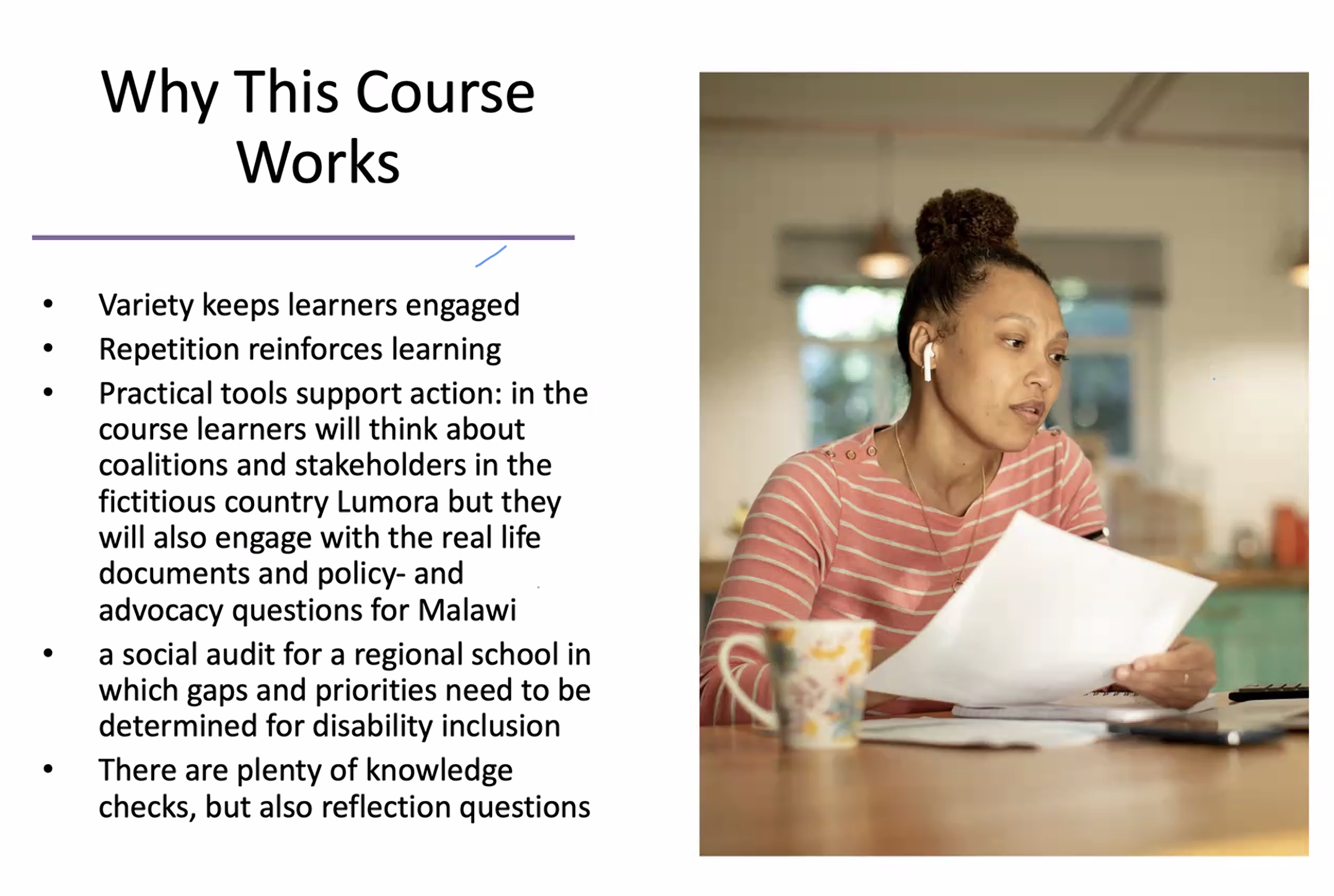
- A detailed Malawi case study and a school social audit to connect national plans with local realities.
- A final, action-focused module that supports participants to apply learning in their own advocacy.
The course uses interactive exercises, case studies, quizzes, and multimedia instead of static text. Participants categorise examples, match concepts, and complete knowledge checks before short quizzes. Five modules include graded assessments (80% pass mark, up to three attempts), with a final module focused on application.
Around 20 short videos, many created for the course, feature dynamic captions, mobile-friendly formats, and real-world examples from GCE members. A video, Small changes, big impact, highlights initiatives in Burundi and South Sudan, showing how everyday actions can reduce dropout rates and strengthen inclusion in fragile contexts.
Challenging norms and enabling reflection
A main aim of the course is to help advocates recognise and challenge harmful gender norms, including their own internalised biases. During the launch, participants reflected on stereotypes they grew up with and how these shape expectations about who studies, who cares, who earns, and who leads.
Within the course, reflective exercises and playful “flip card” activities surface sub-conscious assumptions embedded in everyday situations – from who clears up after gatherings to who stays home with a sick child. These elements are ungraded and designed to encourage honest self-reflection and dialogue, reinforcing that gender transformative education requires changes in mindsets as well as in policies and budgets.
You can see what the participants of the GTE launch had to say about gender stereotypes HERE.
The course provides a suite of downloadable tools and templates that participants can adapt to their contexts, including:
- A Rapid Gender Analysis (RGA) field tool, with clear steps from data collection to advocacy recommendations.
- A completed RGA example, showing how evidence can be turned into advocacy positions.
- A comprehensive Malawi advocacy “blueprint” using real documents and challenges as a model for coalitions elsewhere.
- A school-level social audit framework to assess how inclusive local schools are and how their budgets and practices align with national policies.
These are supported by curated external resources such as UNICEF guidance, and many GCE-produced tools are available in all course languages.
Available in six languages on the GCE Learning Hub
Hosted on the GCE Learning Hub, the course is available in English, French, Portuguese, Spanish, Arabic, and Russian, with voiceovers and interfaces tailored to each language. Participants can access it via the GCE website, by entering the Learning Hub, signing in, or creating an account, and selecting the course in their preferred language.
Learners who complete all modules and pass the five graded quizzes receive a digital certificate from GCE, including verification details so organisations and partners can confirm the credential. A dedicated forum on the Learning Hub allows participants to share reflections, ask questions, and build a community of practice around gender transformative education.
A catalyst for a stronger movement
Closing the launch, GCE Global Coordinator, Grant Kasowanjete, described the course as “more than just modules and materials; it is a tool of action, a catalyst for advocacy, and a pathway to systemic change.” He encouraged participants to use it within their coalitions, communities, and countries to transform commitments towards gender equality into daily realities for excluded and underserved learners.
As GCE’s first course available in Arabic and a flagship multi-language offer, the Learning for Advocacy and Influence on Gender Transformative Education (GTE) course marks a significant step towards a more coordinated civil society movement for gender equality in and through education.
You can view the full Zoom recording here –