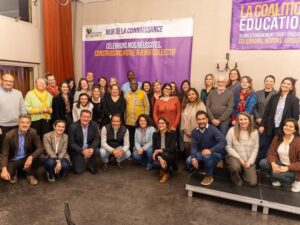
In celebration of the International Day of Education, the Global Campaign for Education (GCE) convened its members for a GCE Political Learning Session on 26 January 2026 to evaluate its collective advocacy in 2025 and strategise for 2026. In line with the theme, “The power of the youth in co-creating education”, GCE lauded its youth and student constituencies in driving transformative change in education and discussed advancing these efforts, given the growing youth activism worldwide.
Read the GCE statement on Youth as Co-Architects of Education HERE.
As civil society organisations face political backlash and restricted political spaces, GCE members drew critical lessons from their engagements at the global, regional and national levels, highlighting effective collaborative strategies to remain steadfast in advancing SDG 4 and the right to education.
Opening the learning session, Grant stated that in light of the global challenges, including climate change, economic volatility and diminishing civic space, GCE cannot allow education to be treated as a privilege, a commodity or a discretionary budget.
Refat Sabbah, GCE President, on the one hand, stressed the need to strengthen members’ political awareness and deepen understanding of contexts as the movement continues to fight for education that stands for equality, justice and humanity. He emphasised that effective social change cannot happen without understanding the political contexts that shape the political decisions that are made. Who holds the power? Which interests enforce policies? Where are the opportunities for influencing at different levels? These questions he said are important for understanding the movement’s advocacy and defining the strategies.
A provocative presentation by Imad Sabi, former GCE Board member, who was part of the team that evaluated 10 years of GCE’s work in 2025, posited the realities of “surviving the 21st century” as GCE navigates the very chaotic and dark period, given that multilateralism and civil society are under systematic attack. Sabi further challenged GCE to connect with the passion of the organic and spontaneous GenZ protests that also demand quality public education, democracy and youth participation.
Drawing critical lessons from GCE members’ work on the right to education, gender transformative education, education in emergencies, education financing and advocacy for SDG 4 within the SDGs, some key takeaways from the GCE Political Learning session are:
- Transform commitment into passion, understand the decision-makers, build alliances and seize the right political moments beyond criticising the governments. There are different centres of power such as the media, international insitutions, corporations and even civil society itself.
- Co-create with the youth their demands and actions with GCE’s advocacy on education and climate change, gender equality, decolonising education finance and meaningful youth participation
- Sustain the movement’s work in bringing evidence from communities and countries into global and regional policy discussions and vice versa, ensuring that international commitments are delivered to fulfil the right to education of marginalised sectors.
- Balance the presence of movements on the ground and having seats at the policy table at global/regional levels, and the need for stronger coordination within its network and with other stakeholders in different spaces
- Localise GCE’s work, enabling opportunities and capacities for national education coalitions to have meaningful participation in education in emergencies, Voluntary National Review, gender-transformative education and education sector planning and financing.
- Broaden GCE’s coalition building with education experts and other alliances, including feminist, public sector, tax justice and debt justice movements, to advance advocacy that delivers meaningful, systemic changes to education.
- Defend multilateralism and support global governance institutions such as the United Nations. The rise of authoritarianism and the attacks on multilateralism diminish the voices of developing countries and threaten CSO participation.
At the end of the GCE political learning session, Grant Kasowanjete announced that Global Action Week 2026 will be on the theme of education financing, aligning GCE’s broad advocacy with the finance campaigns of the Global Partnership for Education and Education Cannot Wait.
You can watch the full learning session on GCE’s YouTube channel –